




Micro drama — vertical episodes of roughly a minute and a half, sixty to a hundred of them in a season — is easy to dismiss as a fad of the feed. It is more interesting than that, because almost every decision in the format is a monetization decision.
The shape of the thing
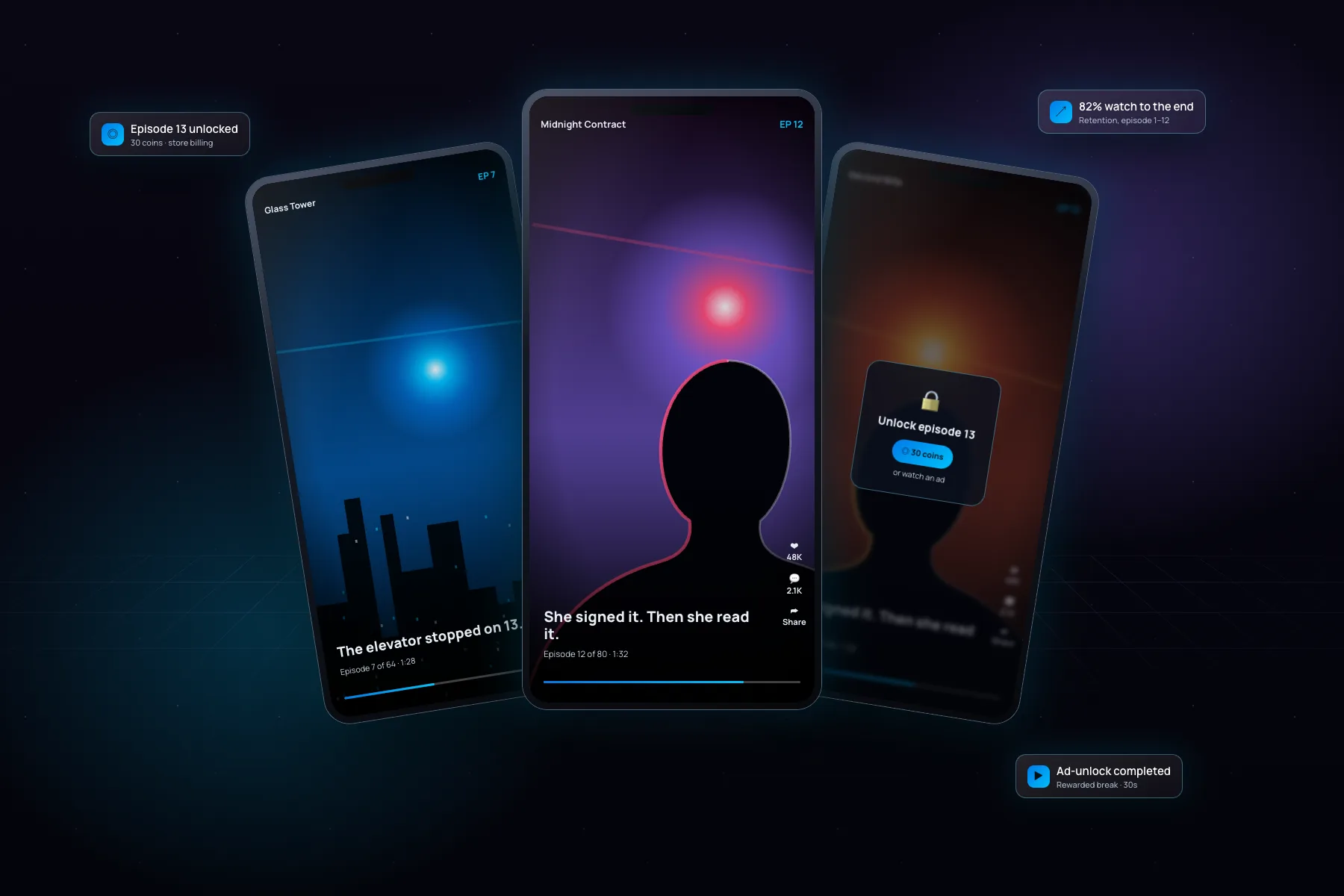
Shot vertical, because that is how a phone is held. Cut short, because that is how long attention lasts between other demands. Written so that each episode ends at a point you cannot comfortably stop at — which is not a new technique, it is the cliffhanger, applied once every ninety seconds instead of once a week.
A season is a single story told across a couple of hours, released all at once. There is no weekly appointment, because the format is not competing with television. It is competing with scrolling.
Free guide
OTT Platform Growth & Monetization Guide
The benchmarks, formulas and ROI scenarios behind a profitable streaming platform. Thirty slides, free.
Where the money is
The economics are unusual. A viewer gets a run of free episodes — enough to be committed to the story — and then hits a paywall placed exactly where leaving is hardest. Beyond it, episodes are unlocked individually against a balance bought in advance.
That structure does two things. It converts at the point of maximum investment rather than at the point of first contact, and it converts in small amounts, repeatedly, rather than asking for a monthly commitment from somebody who has watched four minutes of one story.
What it demands of a platform
A conventional video platform handles this badly, because it was built around titles and subscriptions rather than episodes and balances. The things that matter here are specific:
- A player that is vertical and full-screen, with the next episode already playing before the viewer decides anything.
- Unlocks priced and tracked per episode, against a balance rather than a transaction each time.
- A free run whose length is a setting, not a code change, because where the paywall sits is the number worth testing.
- A rewarded alternative, so a viewer who will not buy can unlock by watching an ad and still be worth something.
- Drop-off reporting at episode granularity. Which episode loses people, and which one they pay at, is the entire business.
Why it travels
Short episodes are cheap to subtitle and cheap to dub, and the stories are deliberately universal. A season that works in one market can be in another one quickly, which is a large part of why the format spread as fast as it did.